CONTEXT & OBJECTIVES
The Centre-Val de Loire Region has placed research and innovation in cosmetics at the heart of its regional innovation strategy. As a leader in the sector, it is home to more than 150 cosmetics companies. It has contributed to the creation of the Cosmetic Valley competitiveness cluster, the world's leading network of industries in the sector, and together with Lombardy, supports the Go4Cosmetics European platform on the digital and green transition.
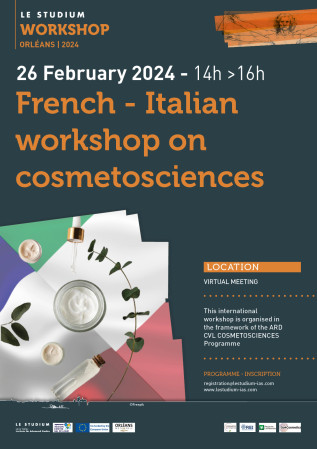
The programme is led by the University of Orléans, in partnership with the University of Tours, the CNRS, Cosmetic Valley and LE STUDIUM Loire Valley IAS. It brings together 12 laboratories and 23 research teams with recognised skills. Research fields covered are plant and biotechnological sourcing, the development of eco-processes for extraction, the characterisation of plant extracts, the formulation and encapsulation of active ingredients, skin biology and the use of new technologies to evaluate the activity and control the safety of cosmetic active ingredients.
RESEARCH
The programme aims to stimulate collaborative research and innovation in cosmetics between academic and industrial laboratories in order to support the development of the cosmetics sector, with a unique positioning on a European scale across the entire value chain, from plant material to finished products.
The currently funded research projects pursue the following topics:
- New ways of obtaining phyto-actives for cosmetics
- Valorisation of poplar root exudates for cosmetics purposes
- Integrated eco-responsible processes for cosmetic ingredients
- Non-invasive method for personalisation of dermo-cosmetic care
- Selective cell extinction for the safety of cosmetic ingredients
MORE
Cosmetosciences programme : https://cosmetosciences.fr/
Reportage Cosmetosciences – 28 October 2016
Interview Dr Bilal Abassi / Prof. Nathalie Guivarc’h