The French Institutes for Advanced Study Fellowship Programme
The French Institutes for Advanced Study Programme* offers 10-month fellowships in the seven institutes of Loire Valley (Orléans-Tours), Cergy, Lyon, Marseille, Montpellier, Nantes, and Paris. Initiated in 2020, the FIAS Fellowship Programme will now run until the 2029-2030 academic year. It welcomes applications from high-level international scholars and scientists wishing to develop their innovative research project in the most innovative scientific regions of France.
The call is open to all disciplines in the social sciences and the humanities (SSH) and relating to all research fields. Research projects in all other sciences and in arts that propose a strong interaction and dialogue with the SSH are eligible. Some host institutes have scientific priorities that need to be taken into full consideration before applying. At LE STUDIUM Loire Valley institute, interdisciplinary projects will be positively considered in the selection process.
Identically to all LE STUDIUM programmes, the FIAS Fellows are free to organise their research while benefiting from the support and conducive scientific environment offered by the institute characterised by a multidisciplinary cohort of fellows and by close relation to the local research centres and laboratories.
To be eligible, applicant researchers must be nationals or long-term residents of a country other than France and comply with the European mobility rules. For applications targeting LE STUDIUM, candidates are invited to consult the list of laboratories based in the Centre-Val de Loire region. The standard duration of the residential fellowship is of 10 months over an academic year i.e. from September through June or October to July.
The annual call for applications opens every year between 2025 and 2028. Applications must be completed online on the FIAS website. Applications submitted by email will not be considered nor evaluated.
The call for applications is now open. The deadline for submission of application is set on Thursday 25th June 2026 at 6:00pm (CET ParisTime)
More information: www.fias-fp.eu
![]() |
*This project has received funding from the European Union’s Horizon 2020 research and innovation programme under the Marie Skłodowska-Curie grant agreement No 101217263 |
Events
Publications
|
This report presents the study based on the hypothesis that integrating rural development into urban planning as a tool for environmental protection aids to reduce the industrialization that causes climate changes. The integration of urban and rural developments into a territorial plan is not only possible but necessary to help the implementation of the SDGs. Applying the methods of bibliographic review, survey research with urban planners, and study case, the project aims to (a) make a comparative analysis of the territorial planning systems in France and Brazil (b) investigate into how the Lefebvre’s “right to the city” can be made applicable to individuals living in peri-urban and rural areas and (c) analyses the Loire Parliament initiative and the “Opération Grand Site”. The study shows the role of international agendas for urban planning and sustainability, the importance of the concepts of urban and rural, that are different but not opposites, and the necessity of investing in urban services for small and medium cities. |
The Chansonnier de Bayeux: An Early Sixteenth-Century Polyphonic Source and Its Polyphonic Relatives
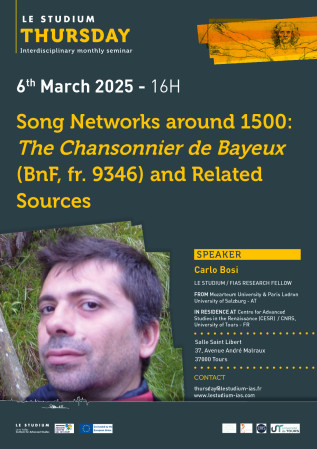
The research focussed on a monophonic chansonnier compiled after 1500 in the context of earlier, contemporary and later musical sources transmitting polyphonic and monophonic concordances and variants of its repertoire, without forgetting the repertoire uniquely transmitted by it. The resulting monograph on the manuscript will include a historical introduction and an online transcription of the melodies with their texts. It will moreover examine a group of songs shared with another monophonic chansonnier, exploring their polyphonic arrangements in related sources and the transformations of music-poetic forms, like the virelai. In examining the spread of various songs from the late fifteenth to the early sixteenth century, this study explores the significance of monophonic songs within the musical landscape of late medieval and early Renaissance France and Europe. Moreover, it reconsiders the concept of ‘variant’, proposing a more nuanced and open conception of ‘musical work’, existing well beyond the traces left in the sources.