
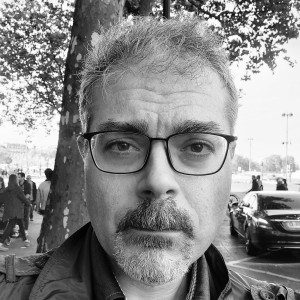
Raffaele Carbone
From
Federico II University of Naples - IT
In residence at
Maison des Sciences sociales et des Humanités Val de Loire (MSH VdL) / CNRS, University of Tours, University of Orléans - FR
Host scientist
Samuel Renier
BIOGRAPHY
Raffaele Carbone is associate professor at the Department of Humanities of Federico II University of Naples, where he teaches History of Philosophy and History of Ideas and directs the ‘Humanism, Arts and Social Research’ laboratory. He was also ‘Directeur de programme’ and vice president of the Assemblée Collégiale at the Collège International de Philosophie. He has carried out extensive research at various institutes of advanced study and research centres in France (CHSPM/ Université Paris 1 Panthéon-Sorbonne, Collegium de Lyon, IEA de Nantes) and Germany (Centre Marc Bloch) and has taught at the universities of Tours and Montpellier 3. His research focuses on early modern philosophy and its influence on contemporary authors, as well as on critical theory. His publications include ‘Différence’ e ‘mélange’ in Montaigne: Mostri, metamorfosi, mescolamenti (Milan-Udine: Mimesis, 2013), La Vision politique de Malebranche (Paris: Classiques Garnier, 2018), the edited volume (in collaboration with Katia Genel) Avant le crepuscule: Réinterroger Horkheimer et l’École de Francfort (Paris: Classiques Garnier, 2026). His new monograph, Modernity and philosophy in Max Horkheimer: On the contemporary relevance of critical theory, will be published in July 2026 by Manchester University Press.
PROJECT
Troubling Scepticism: Uncertainty and Disenchantment in European Societies
In recent years the terms ‘scepticism’ and ‘sceptic’ have once more become fashionable to denote a range of positions from the insinuation of doubt to the denial and rejection of the arguments and evidence provided by scientists, historians, and political scientists on today’s the crucial issues such as the climate crisis, vaccinations, genetically modified foods, and the ongoing global diplomatic and geopolitical tension. Conversely, in the philosophical tradition, the sceptic is the one who doubts, who researches, and who carefully observes. Our hypothesis is that a rethinking of scepticism in its relationship to political and epistemological authorities and sources is possible, starting with an essay that Horkheimer published in 1938, “Montaigne and the function of scepticism”. From a historical perspective, the project aims to study the presence of sceptical attitudes among intellectuals in western Europe after the First World War and up to the beginning of the 1950s, as well as the re-elaborations of older and more modern sceptic attitudes by philosophers of the same period. From a theoretical perspective, the project will develop – also through tools provided by pragmatism and phenomenology – a reflection on the relationship between a sceptical attitude and political positions and explore the complex connection between scepticism, criticism, conformism, and social malaise. On the basis of its general objectives, the research is oriented in two directions: (a) to highlight the implications that scepticism may entail in terms of social feelings and political action, encompassing the various indications provided by the authors who have placed themselves in the sphere of scepticism; (b) to emphasize the specific outcomes which a generalised sceptical attitude entails in junctures marked by acute social and political tensions, as well as the various interpretations that can be provided by the ‘political’ validity of scepticism.