
Cynthia Gabbay

Period 1: October, 2021 to October, 2022
Award: LE STUDIUM Fellowship
Period 2: November, 2022 to December, 2023
Award: LE STUDIUM Guest Researcher
Period 3: October, 2026 to July, 2027
Award: LE STUDIUM / FIAS Fellowship
From
Associate Researcher at the National Scientific and Technical Research Council (CONICET, Argentina), within the Laboratory of Human Sciences (LICH) at the National University of San Martín (UNSAM)
In residence at
Host scientist
Brigitte Natanson
PROJECT 1 (2021-2023)
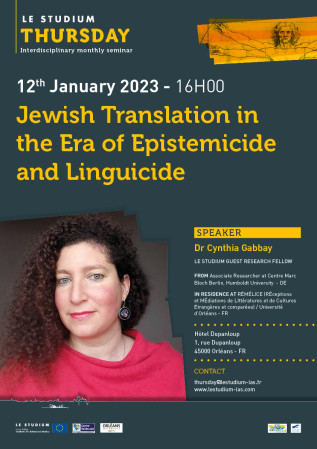
Translation after The Shoah: towards an epistemic recovery of the Jewish Poetic Archive
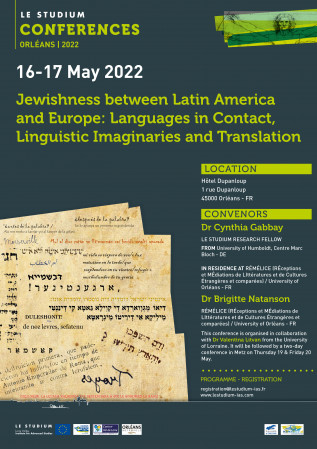
As a resonance of the uprising of Warsaw’s Ghetto (Katzenelson, 1943), the French, Spanish and Judeo-Spanish translations of the Yiddish lament Dos lid funem oisgehargetn Yidishn folk (1943-4) written by the Jewish Polish author Ytsjok Katzenelson, appeared between 1970 and 2008 as follows: Le Chant du peuple juif massacré, by Myriam Novitch et Suzanne Der in 1970 (France), El canto del pueblo judío asesinado, by Eliahu Toker in 1993 (Argentina), Le Chant du peuple juif assassiné, by Batia Baum in 2005 (France) and El kante del puevlo djidyó atemado, by Arnau Pons (Spain) in 2008. These translations in Romance languages added firewood to the already enthusiastic Jewish translating field which transmitted Katzenelson’s testimonial poetry in many other languages. This large phenomenon builds a consensus over this work, identifying it as a unique master piece, one that was written in the antechamber of death.
This project, framed in the interdisciplinary field of Translation Studies (Steiner, 2013; Toury, 1995; Venuti, 1995; Wolf and Fukari, 2007), aims to pursue a comparative examination of these four texts. The study proposes to focus on the poetic forms and language of these translations, and to offer a sociocultural perspective devoted to analyzing their role in the unearthing, symbolic as well as physical, of the Jewish voice and its reincorporation into the contemporary polyglot Jewish archive. The research will explore the intercultural and inter-historical relations that these translations produce, especially in the case of the Judeo-Spanish translation and the role it plays – paradoxically – when translating from one endangered Jewish language (Yiddish) into another one (Judeo-Spanish). These translations will be considered as actions working towards an epistemic recovery of the Jewish poetic archive inhumed during the Shoah.
PROJECT 2 (2026-2027)
Reading Alberto Gerchunoff’s Foundational Jewish Library in Buenos Aires: A Genetic Study of His Book Copies and Marginal Annotations.
This project examines the Jewish library of the Sociedad Hebraica Argentina (SHA) in Buenos Aires, with a focus on the “Sala Gerchunoff” collection, comprising books donated by Alberto Gerchunoff (1883–1950), a foundational figure in Argentine Jewish literature. Through a Genetic Criticism approach, it studies Gerchunoff’s personal copies, particularly their marginal annotations, dedications, and inscriptions, alongside archival and bibliographic sources, to reconstruct his reading practices, intellectual exchanges, and engagement with local and international cultural life. By situating these materials within the history and use of the SHA library, the project contributes to the study of Jewish cultural history in Argentina and to the broader field of Book History.
Events organised by this fellow
Publications
Final reports
This project pursued a comparative examination of the Judeo-Spanish, French and Spanish translations of the lament Dos lid funem oysgehargetn Yidishn folk, written in the antechamber of Auschwitz by the Polish poet Yitzhak Katzenelson (1886-1944).
The study focused on the poetic forms and language of these translations, and offered a sociocultural perspective devoted to analyzing their role in the unearthing, symbolic as well as physical, of the Jewish voice and its reincorporation into the contemporary polyglot Jewish poetic archive. The research explored the intercultural and inter-historical relations that these translations produce, especially in the case of the Judeo-Spanish one and the glottopolitical role it plays when translating between endangered Jewish languages (Yiddish and Judeo-Spanish).
New knowledge was produced on the definition and practice of Jewish translation, its material culture and cultural transmission at the turn of the 20th century and the first decades of the 21st century. Also, light was shed on the epistemic recovery of the Jewish poetic archive through contemporary performances of memory making. In conclusion, this research proposed to recognize Jewish translation within the genre of postmemory.