
Michael Nones

From
Institute of Geophysics Polish Academy of Sciences - PL
In residence at
CItés, TERritoires, Environnement et Sociétés (CITERES) / CNRS, University of Tours - FR & Continental Geo-Hydrosystems (GeHCO), University of Tours - FR
Host scientist
Stéphane Rodrigues
BIOGRAPHY
Michael Nones is an Associate Professor in the Hydrology and Hydrodynamics Department at the Institute of Geophysics, Polish Academy of Sciences in Warsaw, Poland.
His current research focuses on fluvial morphodynamics and geomorphology, combining numerical modelling with remote sensing. He aims to understand how changes in river morphology, riparian vegetation and sediment transport correlate with natural and human drivers to improve water management and land planning.
PROJECT
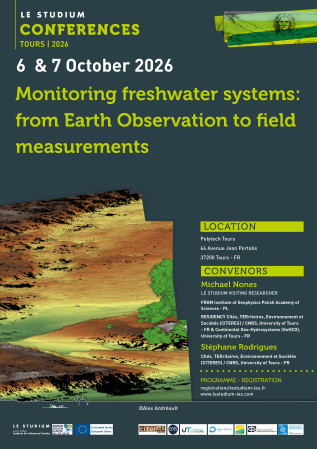
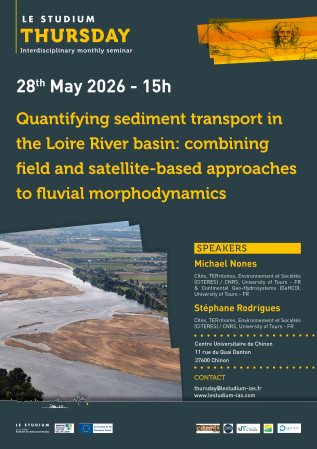
Satellite-based mapping of sediment dynamics and planform mobility in large river basins
Sediments are key elements of river systems, as they determine the morphological changes of the river, influence the quality of habitats along the river, and it can affect different water uses such as drinking water supply, fluvial navigation, energy production, etc. Therefore, understanding both morphological changes in the river planform and the connected sediment transport processes is important. In fact, quantitative information about the transported sediment and channel variations is needed for the characterization of the river dynamics, as well as for providing information for engineering studies related to rivers, e.g., for planning river restoration measures or hydraulic infrastructures.
The present investigation is focused on reach-scale dynamics, analyzing variations in river planform morphology and sediment dynamics, as they play an important role in e.g., floodplain, reservoir or side-channel sedimentation processes.
Focusing on the entire Loire River basin (main river and tributaries), and analyzing the period 1984-2024, the present study aims to i) analyze Landsat and Sentinel images via Google Earth Engine to derive planform dynamics at multiple spatiotemporal scales; ii) correlate those changes with the river hydrology, a proxy of climate change, and the river bed bathymetry; iii) calibrate suspended sediment concentration vs water surface reflectance using monitored data and Landsat 5-9 and Sentinel-2 imagery; iv) spatially and temporarily map sediment dynamics and bank evolution depending on the locations and the river hydrology, to correlate them with land use.
These steps will provide new insights into the spatiotemporal sediment dynamics and morphological planform evolution of the Loire River and its main tributaries, as well as consider how land use impacts those quantities.
Besides providing additional insights on sediment dynamics and morphological changes of watercourses located in the Loire River Basin, this study aims to develop a workflow that could be applied to other large rivers worldwide, as it is easily transferable, and could be replicated in other contexts.
Events organised by this fellow
Publications
Final reports
Suspended sediment concentration (SSC) is a key indicator of river morphodynamics and water quality, yet long-term spatial monitoring remains constrained by sparse in-situ measurements. This study develops a satellite-based framework to estimate SSC along the Loire River (France) over 2005–2025 by combining Landsat 5/7/8/9 imagery processed in Google Earth Engine (GEE) with field SSC observations. A feed-forward neural network (R² = 0.94, RMSE = 3.65 mg/l) was trained on five spectral bands across three turbidity regimes and approximated by a compact surrogate model (R² = 0.89) suitable for operational GEE deployment. SSC maps reveal contrasting morphodynamic behaviour along the reach, with secondary-channel connectivity upstream and channel deepening downstream. River discharge emerged as the dominant SSC control, while rainfall has secondary importance. The approach demonstrates the scalability of combining machine learning and satellite imagery for long-term sediment monitoring in large rivers.