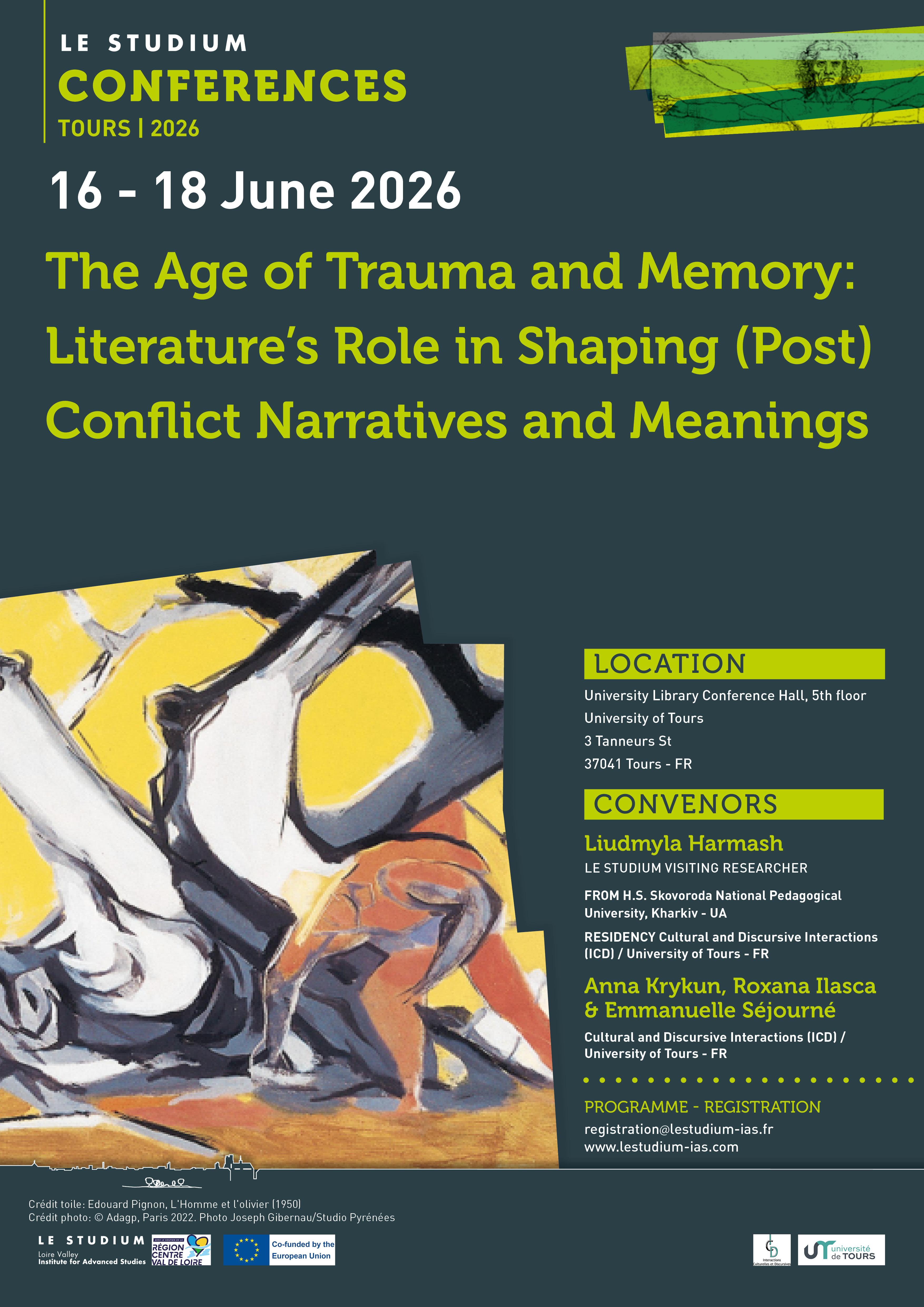
The large genocides of the last century and the subsequent demands for justice have led to a “memorial turn” in the humanities and social sciences. Unlike many other types of discourse that strive to represent the occurrence and to preserve the memory of extreme violence, literature focuses on embodied and partial experiences and perceptions that do not claim to be comprehensive. The international conference 'The Age of Trauma and Memory: Literature’s Role in Shaping (Post)Conflict Narratives and Meanings' responds to the need to rethink the way literature shapes collective memory and (meta)narratives in (post)conflict contexts, in the hope of understanding its anthropological function in contemporary societies, which are largely dominated by new media. It aims to investigate both the narrative forms evoking the experience of organised violence and the way readers engage with narratives of trauma in order to explore not only the expressive side of literary writing but also its performative dimension.
Drawing on case studies from the European context (with a particular focus on the war in Ukraine), but also the Middle East, Africa, Latin America and South Asia, the conference seeks to encourage dialogue between different regimes of memory and different cultural practices.
Convenors
Liudmyla Harmash, LE STUDIUM Visiting Researcher
FROM H.S. Skovoroda National Pedagogical University, Kharkiv - UA
IN RESIDENCE AT Cultural and Discursive Interactions (ICD) / University of Tours - FR
Anna Krykun, Roxana Ilasca & Emmanuelle Séjourné
Cultural and Discursive Interactions (ICD) / University of Tours - FR