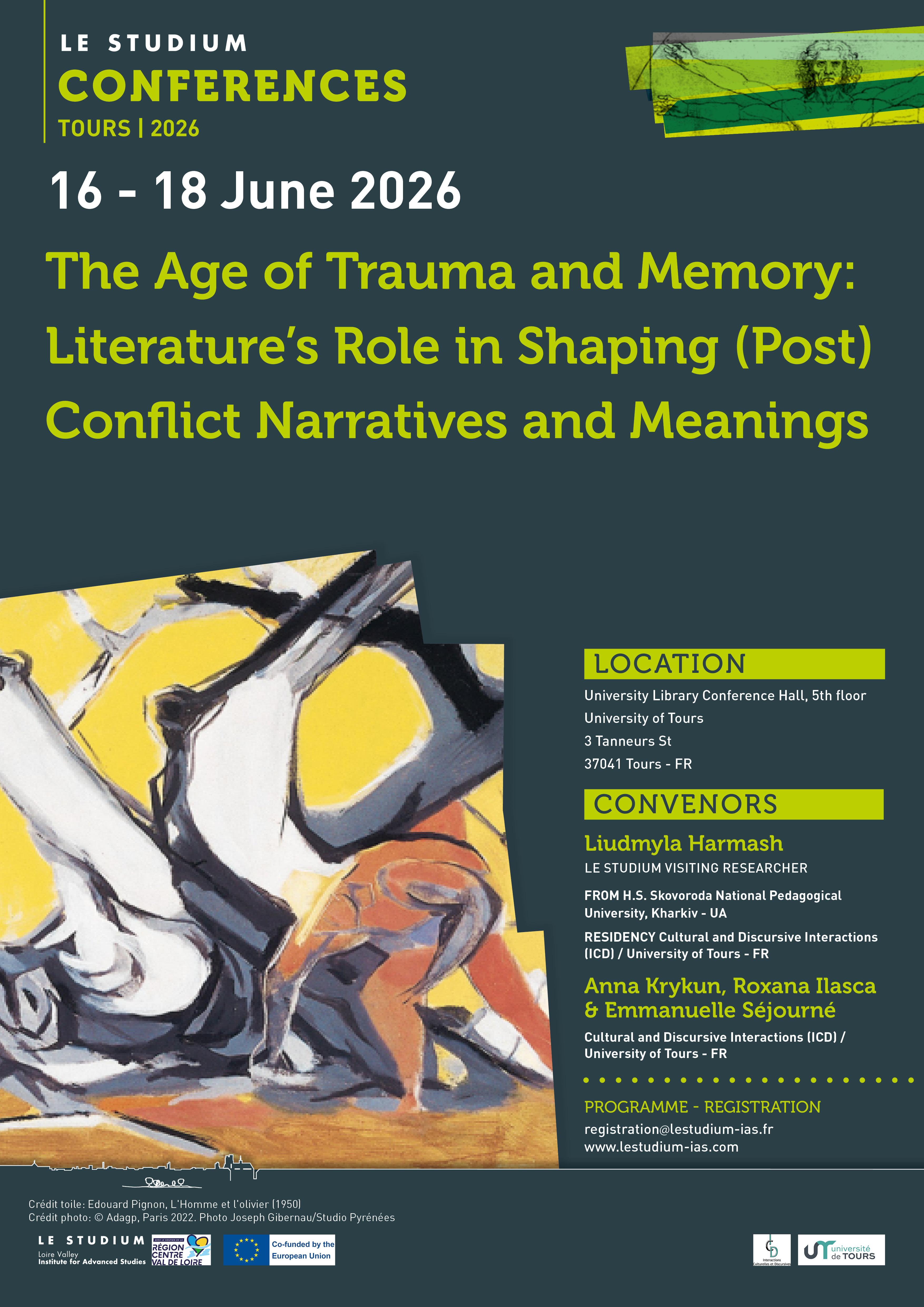
The Age of Trauma and Memory: Literature’s Role in Shaping (Post)Conflict Narratives and Meanings
Bibliothèque universitaire des Tanneurs, 5ème étage
3 rue des Tanneurs
37041 Tours
France
Presentation
The large genocides of the last century and the subsequent demands for justice have led to a “memorial turn” in the humanities and social sciences. Unlike many other types of discourse that strive to represent the occurrence and to preserve the memory of extreme violence, literature focuses on embodied and partial experiences and perceptions that do not claim to be comprehensive. The international conference 'The Age of Trauma and Memory: Literature’s Role in Shaping (Post)Conflict Narratives and Meanings' responds to the need to rethink the way literature shapes collective memory and (meta)narratives in (post)conflict contexts, in the hope of understanding its anthropological function in contemporary societies, which are largely dominated by new media. It aims to investigate both the narrative forms evoking the experience of organised violence and the way readers engage with narratives of trauma in order to explore not only the expressive side of literary writing but also its performative dimension.
Drawing on case studies from the European context (with a particular focus on the war in Ukraine), but also the Middle East, Africa, Latin America and South Asia, the conference seeks to encourage dialogue between different regimes of memory and different cultural practices.
Convenors
Liudmyla Harmash, LE STUDIUM Visiting Researcher
FROM H.S. Skovoroda National Pedagogical University, Kharkiv - UA
IN RESIDENCE AT Cultural and Discursive Interactions (ICD) / University of Tours - FR
Anna Krykun, Roxana Ilasca & Emmanuelle Séjourné
Cultural and Discursive Interactions (ICD) / University of Tours - FR
Programme
Tuesday, 16th of June 2026
- 9:30 Registration
- 9:45 Official opening (Tri Tran, ICD's director, Marie-Hélène Soubeyroux, dean of the Arts and Languages Faculty & Sophie Gabillet, general secretary of Le Studium)
SESSION 1 - Literature as active memory and cultural archive
Chair: Nathalie Champroux
- 10:00 Liudmyla Harmash - The Implied Addressee and the Architecture of Wartime Memory in Contemporary Ukrainian Writing
- 10:30 Anna Dziuban - Traumatic Memory in Contemporary Ukrainian and Irish Literatures
- 11:00 Valeria Morelli - Opening Up Memory: Alternative Narratives in Uwe Timm’s Post-Reunification Literature
- 11:30 Nicole Ong - Literary Witnessing and the Recovery of Silenced Histories
- 12:00 Lunch
SESSION 2 - Difficulties to grasp traumatic past
Chair : Carlos Tous
- 13:30 Alice Laumier - Écrire et lire le trauma historique : le cas Houris
- 14:00 Paola Salerni - Écrire l’indicible par le préverbal archaïque : Mehdi Charef et le récit de ses traumatismes
- 14:30 Theresa Mallmann - Object and Memory: Violence and Testimony in Novels on the Provenance and Restitution Debate
- 15:00 Coffee break
SESSION 3 - Strategies of indirect writing of traumatic experience
Chair: Adrienne Janus
- 15:30 Fedia Berrima - Écrire depuis le décalage : la folie comme dispositif narratif entre l’avant et l’après Révolution de 2011 dans la littérature tunisienne contemporaine
- 16:00 Cécile Torrents - De Fronteras (2007) de Claudia Hernández : l’humour noir pour interroger la mémoire dans le Salvador de l’après-guerre
- 16:30 Mylène Mandart - Le fantastique pour dire ce qui devait être tu : étude des mécanismes stylistiques de deux voix roumaines censurées, Ana Blandiana et Herta Müller
- 19:30 Dinner - La Manufacture
Wednesday, 17th of June 206
- 8:45 Welcome coffee
SESSION 4 - Poetics of extreme violence and trauma
Chair: Cathy Fourez
- 9:00 Álvaro Alcázar Sarrías - Avoir du mal à retrouver une patrie qui n’existe plus : une analyse linguistique et traductologique du traumatisme de l’exil dans Mostarghia, de Maya Ombasic
- 9:30 Marie Gourgues - La memoria intranquila’ : algies mémorielles et ressassement narratorial intergénérationnel dans El boxeador d’Alfons Cervera
- 10:00 Anesa Muslimovic Ortega - Of Parallel Voices and Twisted Identities: Poetics of Trauma, Chronologic Collapse, and Split Identities in Ismet Prcic’s Shards (2011)
- 10:30 Coffee break
SESSION 5 - Fragmentation, diffraction and transmedia reassembling
Chair: Sylvie Mougin
- 11:00 Leena Käosaar - … when we lose even our own reflection’: War, Fracture and Renewal in the Letter-Diary and Visual Art of Viktoria Berezina”
- 11:30 Laure Alexandre - Le théâtre au temps des référendums : autodétermination, migration et mémoires traumatiques dans les ‘petites nations’
- 12:00 Agatha Mohring - Articulation graphico-narrative du traumatisme des camps de concentration français dans le roman graphique espagnol contemporain
- 12:30 Lunch
SESSION 6 - Polyphony in literary narratives and its epistemological and social implications
Chair: Roxana Ilasca
- 14:00 Nursan Celik - Rhythm of Remembering. Poetic Traces of Trauma in Anne Weber’s Annette, ein Heldinnenepos (2020)
- 14:30 Kata Gyuris - Shaping Narratives of the Rwandan Genocide: Trauma, Pan-Africanism, and Multidirectionality
- 15:00 Oksana Shostak - Traumatic Experience and Strategies for Reclaiming National Identity in Contemporary Prose of the Indigenous Peoples of North America
- 15:30 Shorouq Hassan - Polyphonie romanesque et mémoire traumatique de la décennie noire Algérienne dans Houris de Kamel Daoud et Nos Silences de Wahiba Khiari
- 16:00 Coffee break
- 16:15 -17.00 Guided tour of the exhibition ‘Traumatic Memories of the Camps’ by Agatha Mohring
- 19:00 - 20:00 Author talk with Yevgenia Belorusets at the Central City Library of Tours
Thursday, 18th of June 2026
- 9:00 Welcome coffee
- 9:15 Public lecture by Matei Chihaia - Literature and the other arts: echoes of the Spanish Civil War
- 10:15 Coffee break
Session 7 - Relationship between individual and community in critical periods of history
Chair: Nathalie Champroux
- 10:30 Alaïs Le Villain - L’écriture de la violence de la guerre : un lieu de mémoire singulier ou une catharsis collective en Bolivie ?
- 11:00 Etienne Garnier - Trauma et mémoire dans Holocaust (1975) de Charles Reznikoff
- 11:30 Eric Lair - La communauté nationale à l’épreuve. La littérature et le génocide au Rwanda
- 12:00 Emmanuelle Séjourné - Living on Ruins: Tomer Gardi's Literary Essay Stone, Paper (2011)
- 12:30 Lunch break
SESSION 8 - Performative dimension and efficiency of trauma narratives
Chair: Emmanuelle Séjourné
- 14:00 Kryštof Kočtář - Train journey to depths of ‘grave of forgetting’: trauma and affective epistemic knowledge in Alois Nebel trilogy
- 14:30 Milica Resanović, Tijana Matijević & Rodoljub Jovanović - Fiction as Memory Work: Youth Engagement with Yugoslav Wars Through Literary Fiction
- 15:45 Coffee break
Session 9 - Ethics and politics of trauma narratives
Chair: Liudmyla Harmash
- 16:00 Fatima-Zohra Kettaf - Iraq War fiction: Hassan Blasin’s and Phil Klay’s Ethics of Storytelling
- 16:30 Maria Siakalli - Poetry and remembrance: exploring their role in reconciliation and peace-building between Greek Cypriots and Turkish Cypriots in a divided island
- 17:00 Conclusion
- 17:30 Closure Cocktail
General Information
| Congress Venue |
Bibliothèque universitaire des Tanneurs, 5ème étage, 3 rue des Tanneurs
37041 Tours, France
| Dates |
Tuesday, 16 June - Thursday, 18 June 2026
| Language |
The official language of the Congress is English
| Welcome pack and Name Badge |
Upon arrival you will receive a welcome pack that includes the printed material of the Conference and your name badge will be given to you at the reception . Please wear your name badge at all times during the Conference and to all official Conference events.
| Invitation Letters |
An official letter of invitation facilitating the obtention of an entry visa can be sent upon request . In order to receive an invitation letter for visa purposes, send an email to maurine.villiers@lestudium-ias.fr. Please note that :
- we only issue an official letter once the payment of the registration fee has been validated.
- such letters do not represent a commitment on the part of the Organisers to provide any financial assistance.
| Certificate of attendance |
After the conference, in order to receive a certficate of participation, send an email to maurine.villiers@lestudium-ias.fr
How to get there ?
| By train: |
* Tours centre station
1.5 hour trip from Paris (Montparnasse)
* Saint Pierre des Corps (4km from Tours town centre)
Bus 5, 20 minutes trip to Tours centre station
> Plan your trip by train: https://www.sncf-connect.com/en-en/
| By tramway: |
14 minutes trip from Tours centre station 2
> Take Tramway A in direction to Vaucanson, step out at Porte de Loire
The Bibliothèque universitaire des Tanneurs is an 8-minutes walk from the stop.
| By bus: |
16 minutes trip from Tours centre station 3
> Take Bus 14 in direction to Sante Nct+, step out at Ile Simon
The Bibliothèque universitaire des Tanneurs is an 4-minutes walk from the stop.
| By car: |
GPS: 47.39616130890378, 0.682174374938746
Paid car parks nearby :
Parking Indigo Anatole France, 113 Pl. Anatole France, 37000 Tours
| By plane: |
*Arrival at Roissy Charles De Gaulle (CDG) airport:
Take RER B in direction to Orsay-Ville, step out at Denfert Rochereau Stop
Metro 6 in direction to Charles de Gaulle-Etoile, step out at Montparnasse Bienvenue Stop
> Then take a train to Tours (see "by train" section above)
*Arrival at Paris-Orly (ORY) airport:
Take Metro 14 in direction to Saint-Denis Pleyel, step out at Bercy
Take Metro 6 in direction to Charles de Gaulle-Etoile, step out at Montparnasse Bienvenue
> Then take a train to Tours (see "by train" section above)
Pricing
| Speakers | 50 EUR |
| Participants | 75 EUR |
Cancellation Policy
All cancellations must be made in writing and sent by email to the Registration Department
Up to 30 days prior to conference start – Full refund less €50 handling fee
Less than 30 days prior to conference start – No refund