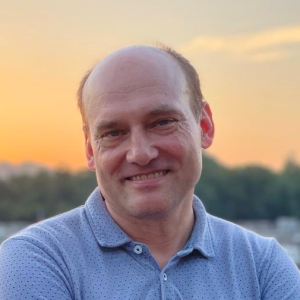
Alexander Molochkov
From
Beijing Institute of Technology - CN
In residence at
Institut Denis Poisson / CNRS, University of Orléans, University of Tours - FR
Host scientist
Maxim Chernodub
BIOGRAPHY
Alexander Molochkov has 28 years of experience in theoretical physics. His present research interests are the development of numerical modelling using lattice field theory methods as a powerful tool for the study of strongly correlated systems under different conditions and geometries. In particular, he develops applications of lattice field theories to address, on the same footing, problems in the biological, high-energy, and condensed matter branches of physics. Within this general research direction, Alexander established and developed the Pacific Quantum Center in collaboration with Tours University. Currently, Alexander is a Visiting Professor at the Beijing Institute of Mathematical Studies and Applications.
PROJECT
Extending frontiers in condensed matter and particle physics through computational field theory methods
The project encompasses broad avenues in the quantum field theories, with the research component ranging from the investigation of particle physics systems to zero-point energy and anomalous transport in nanomechanical systems. These research areas appear in our project on the same footing via a unifying role of lattice gauge theories. We will borrow well-developed numerical techniques and established analytical methods from lattice gauge theories to address current problems in the quantum anomalies and finite system zero-point (Casimir) energies in high-energy and solid-state branches of physics.
The topics of interest include quantum anomalies, thermodynamic phases, finite-size Casimir effects, and topologically protected classical solutions. The phenomena have their counterparts in condensed matter physics. The project aims to study these effects in polymers, newly discovered quantum materials, and particle physics systems.
Events organised by this fellow