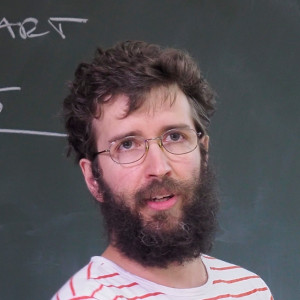
Sebastián Franchino-Viñas
From
National University of La Plata - AR
In residence at
Institut Denis Poisson / CNRS, University of Orléans, University of Tours - FR
Host scientist
Maxim Chernodub
BIOGRAPHY
Sebastián Franchino-Viñas received his Ph.D in Physics from the Universidad Nacional de La Plata in 2016 and is currently a permanent researcher at CONICET. He has held postdoctoral positions at Friedrich Schiller Universität Jena, Ruprecht-Karls-Universität Heidelberg, Helmholtz-Zentrum Dresden-Rossendorf and Universitá di Genova. His research focuses on developing analytical techniques to investigate quantum field theories in the presence of extreme physical environments, with particular emphasis on gravitational and electromagnetic backgrounds.
PROJECT
Quantum effects in gravity: nonperturbative techniques for extreme environments
Modern laboratory techniques provide access to unprecedented extreme environments, such as those generated by the strong electromagnetic fields achieved with the latest generation of laser facilities. It is also agreed that strong fields (gravitational and electromagnetic) are frequent in our universe, dominating the early epoch and in the vicinity of compact objects, with consequences that are expected to be accessible with current/near future observational missions. The natural language for understanding the nonperturbative phenomena that take place in such environments is that of quantum field theory.
Quantum field theory in the presence of background fields also forms the backbone of our current wisdom of high energy physics, comprising a huge variety of phenomena as the Higgs mechanism, the Casimir and related vacuum effects and the behaviour of fields in curved spacetime. A fundamental fact is that backgrounds introduce instabilities in the trivial quantum vacuum, exciting multiparticle states and giving rise to a variety of observable effects.
This proposal aims at developing a solid approach to nonperturbative methods in quantum field theory in strong background fields and, in the long term, explore its applications in cosmology and condensed matter physics, offering a fresh insight into their physics, while using diverse modern techniques, including resummations, heat kernels, entanglement entropy and anomalies.