
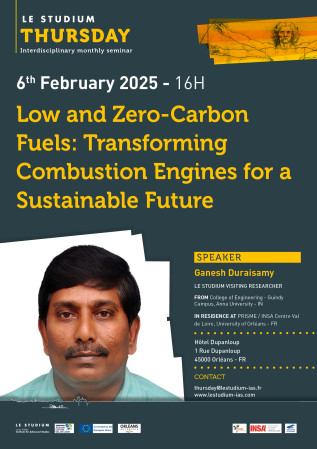
Ganesh Duraisamy

From
College of Engineering - Guindy Campus, Anna University - IN
In residence at
PRISME / INSA Centre Val de Loire, University of Orléans - FR
Host scientist
Christine Rousselle
BIOGRAPHY
Dr Ganesh Duraisamy obtained his Bachelor's degree in Mechanical Engineering in the year 2000 from the University of Madras and Master's degree in Internal Combustion Engineering in the year 2002 from Anna University, Chennai, Tamil Nadu, India. He joined as a Lecturer in the Department of Mechanical Engineering at Anna University in the year 2003 and completed his Ph.D. in Mechanical Engineering with a specialisation in low temperature combustion in the year 2011. He received a Mass-Cargo endowment award for guiding best research project in thermal stream in the year 2012 from Anna University. He was also awarded an Indo-US Raman post-doctoral fellowship by UGC, New Delhi in the year 2013 and pursued his Post-Doctoral research in the field of reactivity controlled compression ignition (RCCI) combustion at the Engine Research Center, University of Wisconsin, Madison, USA from 2013 to 2014. He rejoined Anna University after completing his post doctoral research where he is now currently serving as a Professor since 2018. His thrust areas of research include Low-Temperature Combustion techniques in IC Engines, Flexi Fuel Engines, Low and zero-carbon fuels, and Hybrid IC engines. He has developed Methanol/Diesel and Methanol/DME dual fuel combustion engines along with the Indian OEM partner M/s Ashok Leyland by modifying their commercial light-duty diesel engine through a Government of India funded research project (2016-2019) under clean energy research initiative (CERI) scheme. He has strong national and international collaborations with the institutions such as IIT Madras, Aston University, Birmingham, UK, and Tianjin University, China through DST-UKIERI (2019-2021) and MHRD-SPARC (2019-2023), Government of India funded projects titled “Waste to Engine : Low-Temperature Combustion of Sustainable Green Fuels” and “Experimental Investigations on Gasoline Like High Volatile Low Reactive Fuels in Advanced Diesel Combustion Modes”. Currently, Prof. Ganesh Duraisamy is focusing on the Potential of Low (Methanol, DME) and Zero Carbon (NH3 and H2) Fuels in High-Efficiency Clean Combustion Engines for stationary power generation and automotive applications. He has more than 20 years of experience in teaching and research, and has published over 60 research articles in peer reviewed journals and conferences.
PROJECT
Potential of zero and low carbon fuels in high-efficiency clean combustion engines
Recently ammonia (NH3) attracted attention as a carbon-free fuel for non-road and marine engine applications.
NH3 combustion technology must be established in internal combustion engines to use NH3 as a fuel in non-road and marine engines. However, NH3 combustion in internal combustion engines has several challenges such as difficulty in ignition due to high auto-ignition temperature, slow chemical kinetics, higher oxides of nitrogen
(NOx), and unburnt ammonia emissions compared to conventional gasoline and diesel combustion. In particular,
nitrous oxide (N2O) which has 265 times higher global warming potential than CO2, must be carefully addressed. To achieve auto-ignition of NH3, improve chemical kinetics, reduce NOx and N2O, a zero and
low-carbon fueled reactivity-controlled compression ignition (RCCI) combustion mode would be adopted in the
present investigation. In the present investigation, NH3 and dimethyl ether (DME) have been proposed as low and high-reactivity fuels respectively. DME is a potential high reactivity fuel because of its high cetane number than
diesel, exists in the gas phase at atmospheric conditions, and has lower liquefication pressure (around 6 bar). In addition, the absence of c-c bonding and its lower carbon content ensures soot-free and reduced carbon emissions.
Hence, using NH3/DME as dual fuels and adopting intelligent fuel injection strategies would burn
NH3 efficiently. Both NH3 and DME have lower liquefication pressure, hence both fuels can be injected in the gaseous and liquid phases at the intake and compression strokes to create required fuel reactivity stratification.
Different ammonia fuel reactivity stratification strategies are proposed to investigate its mixing as well as combustion process experimentally in an optical and compression ignition (CI) engine. By investigating the mixing
and combustion process of NH3/DME-air, the best suitable NH3 fuel reactivity stratification strategy would be selected. With the chosen NH3 stratification strategy, experiments would be performed on a commercial single-cylinder, non-road, modified CI engine for a detailed investigation of combustion, performance, and emissions.
Events organised by this fellow
Publications
Final reports
|
Achieving the European Green Deal objectives and global net-zero targets requires rapid decarbonization of the transport sector, which remains a significant source of greenhouse gas emissions. While electrification is expanding, long vehicle lifecycles and infrastructure limitations necessitate complementary low-carbon solutions that can be integrated into existing engine platforms. Ammonia (NH₃) is emerging as a strategic zero-carbon energy carrier because it contains no carbon, can be produced from renewable electricity, and benefits from established global storage and distribution infrastructure. However, its slow ignition and poor combustion reactivity limit direct application in internal combustion engines. This research evaluates the use of small quantities of dimethyl ether (DME) as an ignition promoter to enable stable and efficient ammonia combustion under multiple operating modes. The results demonstrate that minimal DME addition significantly enhances ignition reliability, combustion stability, and efficiency while maintaining low carbon emissions. By enabling the use of ammonia in existing engine technologies, this work supports near-term emission reduction strategies, strengthens energy security by reducing fossil fuel dependence, and contributes to Indo-French scientific collaboration aligned with European climate and innovation policies. |