Halogens play an important role in volcanic systems and their environmental impacts, alongside the main volcanic volatiles (water-vapor, carbon dioxide, and sulfur). Volcanic halogens (fluorine, chlorine, bromine, and iodine) influence the evolution of magmatic systems over time, the transport and fate of metals, and degassing processes leading to passive and eruptive emissions. On entering the atmosphere, halogens in volcanic emission-plumes can undergo chemical reactions that impact atmospheric chemistry, ozone and climate, and exert further influences on the environment and ecosystems by their deposition. Volcanic halogens interact with co-emitted ash particles and can influence the nitrogen, sulfur, and mercury cycles.
Tracing volcanic halogens behavior and fate alongside other volatiles in the volcano-atmosphere-environment system is a complex challenge. Recent advances and newly developed research tools across laboratory experiments, field/observation and model studies are enabling to better quantify and characterize volcanic halogens processes within each of the various earth compartments and to bridge knowledge gaps from the mantle to the atmosphere. When brought together, these advances can collectively inform about the environmental impacts of volcanic halogens, their influence on largescale cycles and their evolution in the earth system (and for other planets), and the potential use of volcanic halogens datasets to contribute to observatory efforts to monitor and predict eruption hazards.
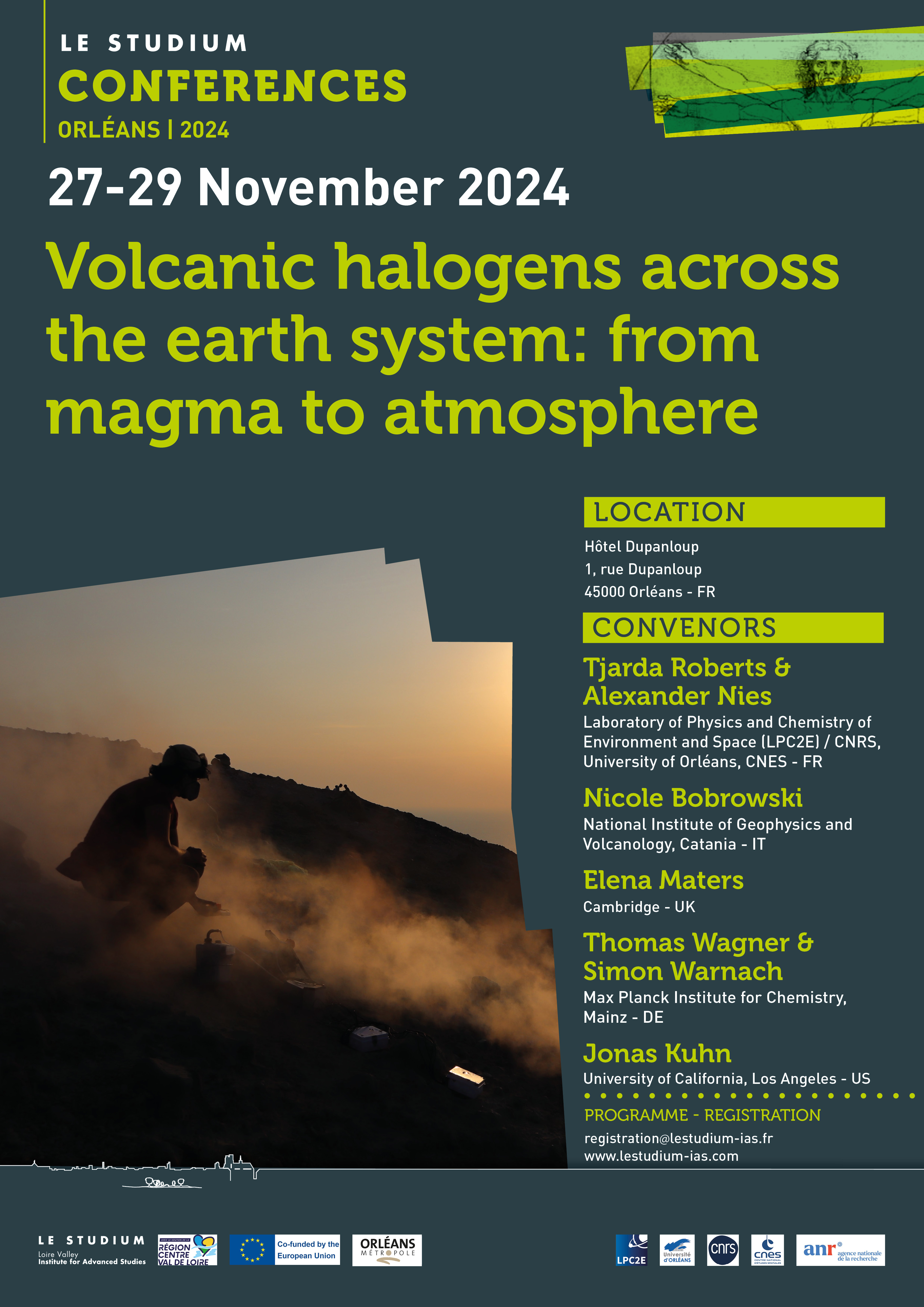
We seek to gather together the earth-science and chemistry-climate communities - from France and Internationally - for a multidisciplinary workshop to share our research on volcanic halogens.
This workshop is sponsored by the LEFE CHAT, LE STUDIUM, the H’allo Volcano International Consortium and the ANR Consortium VOLC-HAL-CLIM.
CONVENORS
- Tjarda Roberts,
Laboratory of Physics and Chemistry of Environment and Space (LPC2E) / CNRS, University of Orléans, CNES - FR - Nicole Bobrowski,
National Institute of Geophysics and Volcanology, Catania - IT - Elena Maters,
Cambridge - UK - Alexander Nies,
Laboratory of Physics and Chemistry of Environment and Space (LPC2E) / CNRS, University of Orléans, CNES - FR - Thomas Wagner,
Max Planck Institute for Chemistry, Mainz - DE - Simon Warnach,
Max Planck Institute for Chemistry, Mainz - DE - Jonas Kuhn,
University of California, Los Angeles - USA