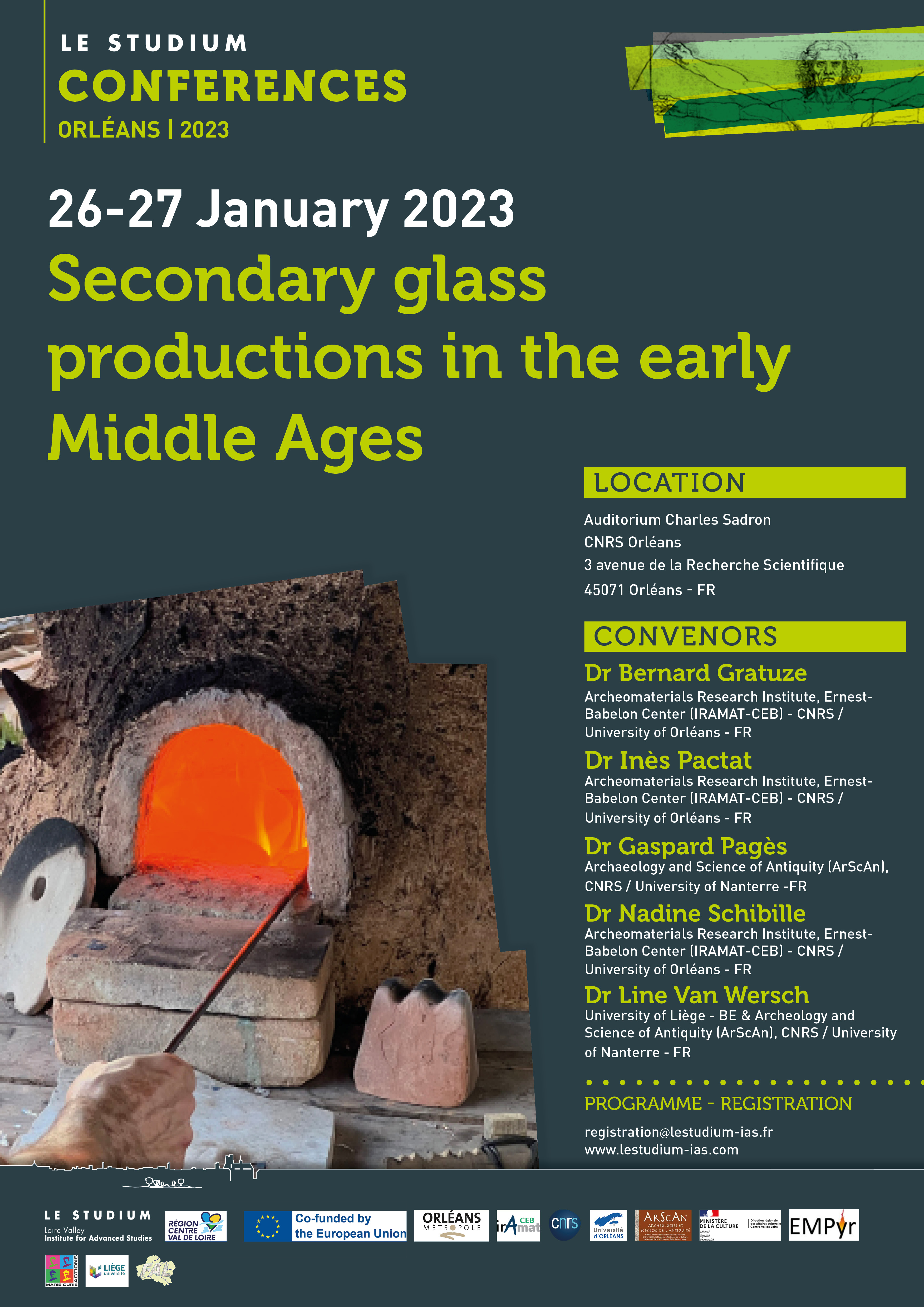
If glass production from the Antiquity is quite well-known, the period after the fall of the western roman Empire is still a field to investigate.
In Western Europe, this period is even more important that it corresponds to the transition of the fluxing agent that will allow a complete reorganization of the production. That time also knew itinerant glassmakers travelling between abbeys and agglomerations who could contribute to the diffusion of new practices and recipes. Recently, several production sites have been discovered during excavations and research projects focused on that period, considering both archaeological aspects and the material compositions. Therefore, we would like to gather the scholars working on that topic in order to compare the sites of production, their tools and products on a large geographical scale.
Topics reached:
* Environments of the production:
- Inventories of workshops (means, tools, characteristics considered).
- Workshops in the landscape, in the agglomerations, monasteries or emporia.
- Locations of the workshops regarding the other crafts, the organization of the settlements, the different buildings.
- Location regarding the communication means and the resources.
*From the workshops:
- Structures, techniques and materials used by the glassmakers.
- What is produced and what is reused or recycled?
- Can we identify specific workshops for specific productions?
- Can we define a production from morphological, technical or chemical characteristics?
- Can we define products with specific social status (luxury products, Christian products, …) ?
* The artisans:
- What was the status of the artisans.
- Did different glass artisans exist? Were beads and tesserae "glass productions"?
- What can we learn about the glassmakers form their tools (experimental archaeology)?
* Imputs and output to and from other crafts
- Metals for tools or coloring process.
- Ceramic for crucibles and kilns.
- Common practices and materials between pyrotechnologies.
Convenors
- Dr Bernard Gratuze, Archeomaterials Research Institute, Ernest-Babelon Center (IRAMAT-CEB) - CNRS / University of Orléans - FR
- Dr Inès Pactat, Archeomaterials Research Institute, Ernest-Babelon Center (IRAMAT-CEB) - CNRS / University of Orléans - FR
- Dr Gaspard Pagès, Archaeology and Science of Antiquity (ArScAn), CNRS / University of Nanterre - FR
- Dr Nadine Schibille, Archeomaterials Research Institute, Ernest-Babelon Center (IRAMAT-CEB) - CNRS / University of Orléans - FR
- Dr Line Van Wersch, University of Liège - BE & Archaeology and Science of Antiquity (ArScAn), CNRS / University of Nanterre - FR
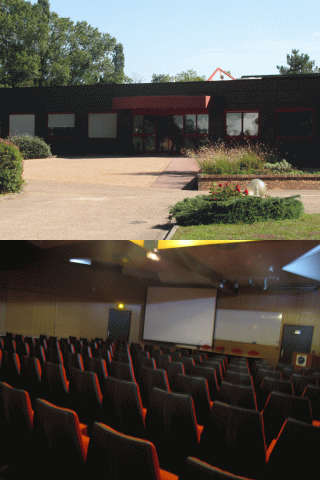
Location