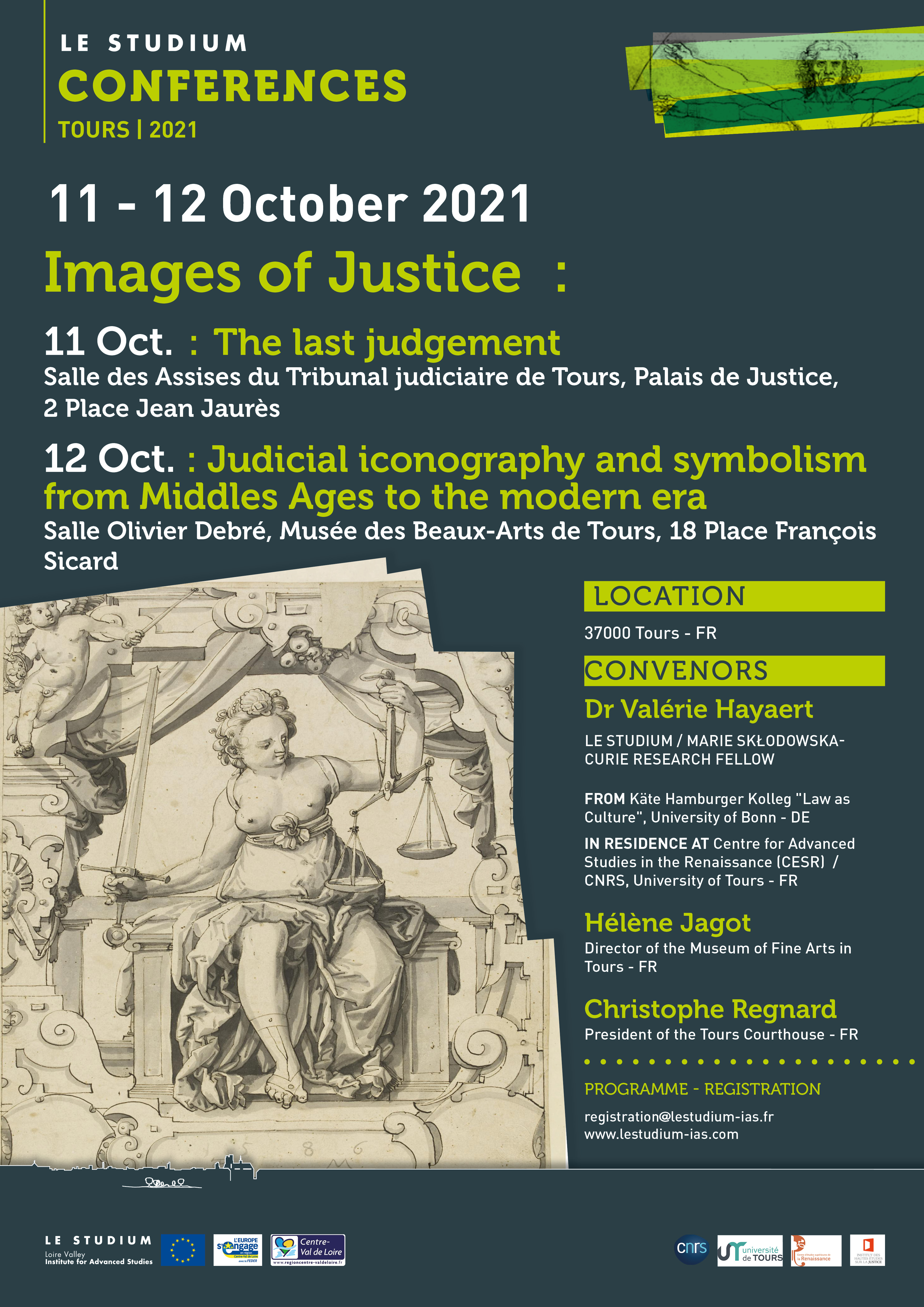
In the last three decades, beginning in 1994 with a major work by Robert Jacob, there has been a renascence of writing of images of Justice, judicial iconography and courthouse architecture.
In 2016 and 2018, following two major exhibitions held in Bruges and Mechelen to which I contributed, I was able to weave a more reflective understanding of what happens when a viewer encounters an embodied image of justice, whether this artifact is a painting, a sculpture, or an object, trapped into a meaningful judicial ritual (eg. shaming practices, "amende honorable", executions in effigy).
These investigations were born out of a fruitful dialogue between curators, legal professionals and researchers. An image of justice is no longer imagined as an immobile artwork, or an opportunity for religious or historical narrative out of its primary judicial context but as an imaging process involving several functions (didactic, persuasive, mnemonic, deontological roles). In Europe, most of our contemporary courthouses are symbolically silent. A reflective evaluation of the functions of judicial images in the "longue durée" is a useful ally to revive the foundational principles of fair trial and due process.
Bringing together researchers and legal professionals, as well as curators and heritage specialists, this event also wishes to connect participants to the ways in which a figure of Christian Judgment has been constantly reinvented throughout the centuries. The idea is to look at artworks 'in situ' from a legal and societal perspective, explaining their key role as symbols.
Convenors
- Dr Valérie Hayaert, LE STUDIUM / Marie Skłodowska-Curie Research Fellow
FROM : Käte Hamburger Kolleg "Law as Culture", University of Bonn - DE
IN RESIDENCE AT: Centre for Advanced Studies in the Renaissance (CESR) / CNRS, University of Tours - FR - Hélène Jagot
Director of the Museum of Fine Arts in Tours - FR - Christophe Regnard,
President of the Tours Courthouse - FR