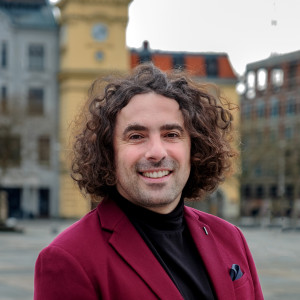
Jan Lazar
From
In residence at
Institute of Interdisciplinary Law Research (IRJI) / University of Tours - FR
Host scientist
Fabienne Labelle
BIOGRAPHY
Jan Lazar, is an Associate Professor of Romance Languages specializing in French linguistics, with a primary focus on the language policy of France, the penetration of Anglicisms into the French language, and the fight against them. He has taught at the University of Ostrava (Czech Republic) since 2010 and the University of Opole (Poland) since 2011.
He holds degrees from the University of Ostrava (Mgr., 2004) and Palacký University Olomouc (Ph.D., 2009), and completed his habilitation at Charles University in Prague (2020). He previously gained pedagogical experience at secondary grammar schools, the Prague University of Economics and Business (VŠE), and Czech government ministries.
An active international researcher, he is a recipient of a 2026 Fulbright Scholarship at University of New Orleans (USA), served as a Visiting Professor (2018) and Research Fellow (2023) at Université Paul Valéry Montpellier III (France), and was a scholar at Université de Liège (Belgium). He has also delivered guest lectures in numerous countries, including the USA, France, Poland, Spain, Cuba, Portugal, and Hungary.
He serves on scientific committees, peer-reviews for prestigious linguistic journals, and is an active member of key professional bodies, including Gallica, SUF (Czech Association), and FIPF-CECO (International Association)
PROJECT
Penetration of neological loan-words from English into French and Czech legal language
The French legal language (le langage juridique), traditionally defined by its precision and rooted in the Napoleonic Code, is facing unprecedented pressure from economic globalization and the dominance of Common Law. The primary objective of this project is to investigate the penetration of Anglicisms into French legal language—particularly within corporate law, finance, and international arbitration—which has led to the emergence of a hybrid "Franglais juridique." Simultaneously, the project evaluates the competitiveness of official French legal terms, specifically analyzing to what extent the alternative terminologies proposed by official language commissions (such as those in the FranceTerme database under the Toubon Law framework) can successfully compete with their dominant English counterparts. Ultimately, the study explores how the French civil law tradition can maintain its linguistic sovereignty and clarity in a globalized world, drawing a comparative parallel with the Czech legal system, which faces an identical wave of Anglicisms.

|

|