
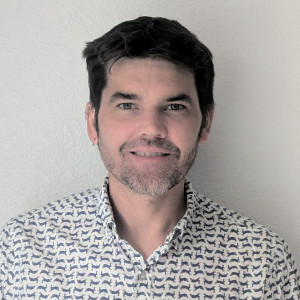
Thomas Shea
From
University of Hawai'i at Manoa - US
In residence at
Earth sciences institute of Orleans (ISTO) - CNRS, BRGM, OSUC / University of Orléans - FR
Host scientist
Estelle Rose-Koga
BIOGRAPHY
Prof. Tom Shea was born and raised in France, pursuing studies in Earth Sciences in Montpellier and Clermont-Ferrand until obtaining a Master's degree in Volcanology and moving to the University of Hawai'i (United States) for his PhD degree in 2007. Tom obtained his PhD degree in 2010 and stayed close to his Hawaiian volcanoes ever since, first as a postdoctoral researcher and now, as an associate professor. He has been eagerly researching volcanoes, combining field work and mapping with laboratory experiments, computer models, and state-of-the-art chemical analyses of lavas erupted worldwide. He built expertise in volcanology by international collaboration with numerous colleagues and is currently investigating how minerals in magmas record their complex underground history as well as the timing of important magmatic events prior to eruptions. He shares diverse interests in Earth Sciences, and a thirst to understand the driving forces behind volcanic eruptions to better prepare residents for these natural hazards.
PROJECT
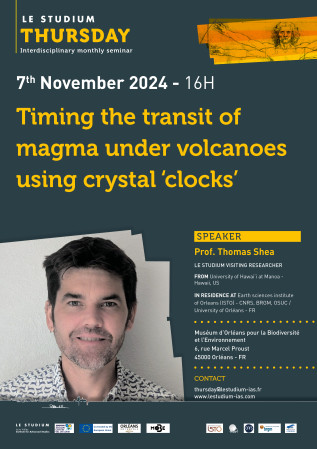
Timing Magma Transit in the Earth using Crystal Clocks
Volcanology is the branch of science that strives to understand how magmas are formed within the Earth, how they transit from the depths to the surface, and the various processes they undergo during their storage and transport before eruption. Diffusion chronometry is a recently booming field of volcanology, where spatial variations in the chemical information preserved in minerals and volcanic glass are leveraged to extract precious time information. Like tree rings, magmatic crystals display sharp variations in elemental compositions from their cores to their rims as they grow. These sharp changes tend to become more gradual as elements move from one region of the mineral to the other, at rates that have been calibrated in the laboratory. By studying the degree of smearing or diffusion of these elements, it is possible to calculate how long it took for between the time these minerals grew and eruption. This information is critical in order to understand how long magma chambers undergo recharge and unrest before an eruption. These 'crystal clocks' therefore require the movement rates of atoms in minerals to be well calibrated in the lab. However, a recent study from our group has shown problems with these calibrations, mainly due to the fact that experiments have largely studied diffusion between minerals and not for minerals surrounded by magma/melt. For this STUDIUM project, we propose to study diffusion in feldspar surrounded by basalt melt in one the world's most prominent experimental volcanology lab (ISTO in Orleans). Feldspar is nearly ubiquitous in basaltic magmas on earth. If, like in other minerals we studied, diffusion is much faster in the presence of melt, the community would have to reassess the timescales that were previously derived by diffusion chronometry. And crystal clock science would enter a new era in which experimental calibrations of diffusion rates would need to incorporate the effects of liquid melt.
Events organised by this fellow
Publications
Final reports
The booming field of diffusion chronometry allows geoscientists to extract the timing and duration of subsurface magmatic processes that occur prior to volcanic eruptions. The technique relies on modeling step-wise, concentric chemical gradients that form within magmatic minerals as they grow or get perturbed by new incoming magma prior to volcanic unrest. These chemical ‘tree rings’ are smeared with time by element diffusion, so that the amount of time between perturbation and eruption can be recovered if the mobility (diffusivity) of elements is calibrated in the lab at magma temperatures. This project aims to resolve recently uncovered discrepancies between widely-used element diffusivities obtained in simplified systems (e.g., mineral-mineral couples) and those obtained in melt bearing systems (mineral-melt couples). The new experiments carried out during a STUDIUM-supported sabbatical in 2024-2025 confirmed that the presence of melt is responsible for important differences in element mobilities for olivine, perhaps via the presence of H2O. Diffusivities in plagioclase, by contrast, are not influenced by melt or H2O, implying that current community practices are robust. The underlying mechanisms by which these differences in element behavior appear are still being investigated, and new tools recently tested (hyperspectral cathodoluminescence) may hold important clues as to the presence and distribution of point defects in these minerals.