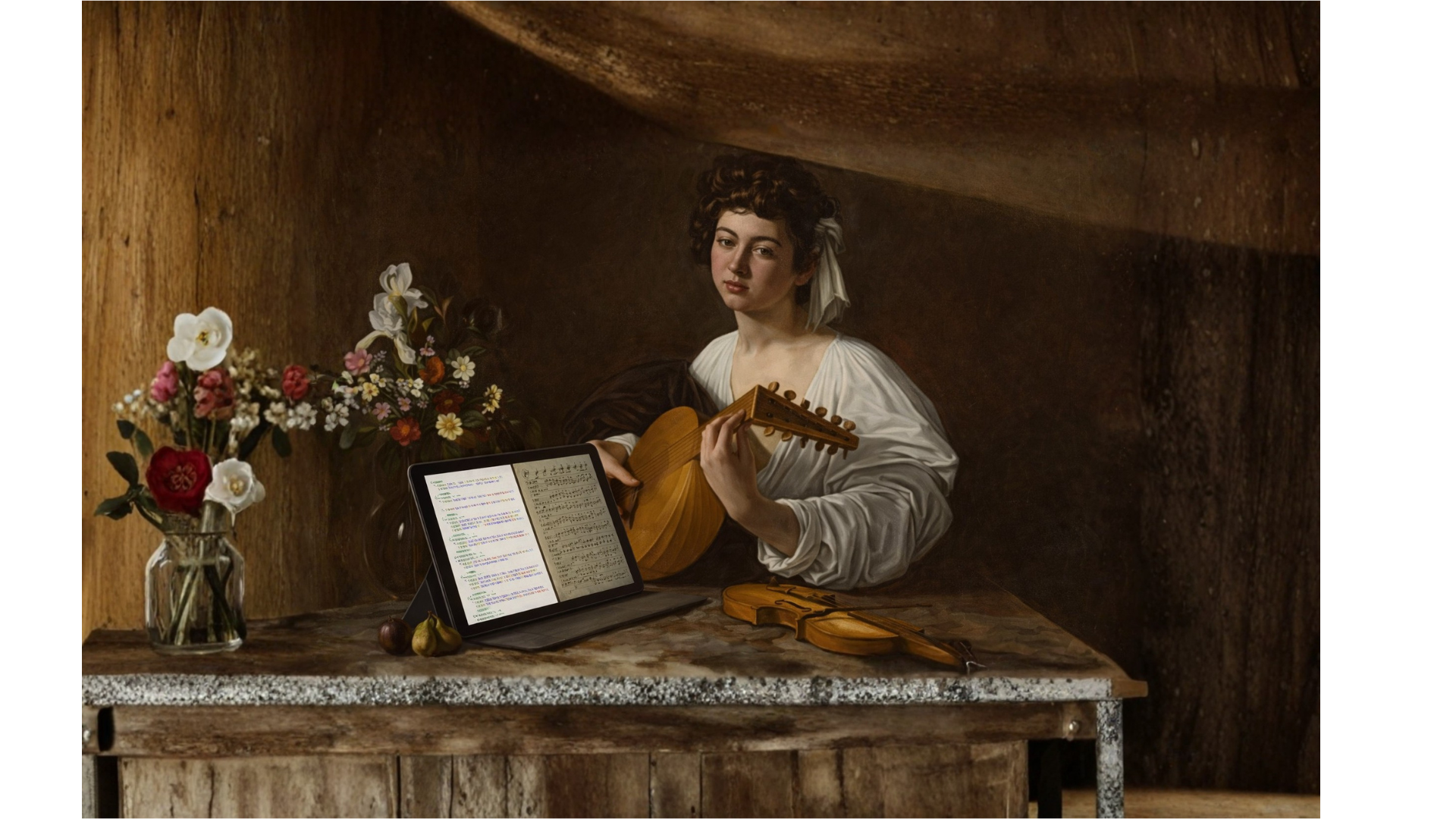
Tablature and Technology for Tomorrow
Coordinator of the consortium: Philippe Vendrix & Ailin Arjmand, Centre for Advanced Studies in the Renaissance (CESR) / CNRS, University of Tours - FR
Summary
This project concerns the large repertoire—over 70,000 musical works— written in tablatures during the period c. 1500-1750. It challenges the assimilation into the history of Western music of a huge yet marginalised repertoire that has never been fully examined or understood. The aim of this project is to rectify this imbalanced view of Western musical heritage through strategies, guidelines and tools directed towards a balanced contemporary historiography.
The general aim of the project is to bring about the acceptance of tablature repertories and to see them assimilated into the broader field of Western music and its heritage. The international Consortium working towards these goals comprises leading scholars from France, the United Kingdom, Austria, Poland and Australia.
New digital technologies are at the core of this development. These can enable the assimilation of music notated in tablature through strategies based on digital tools that can overcome the barriers that have previously impeded such goals. This involves 1) the development of MEI encoding for tablature, 2) the implementation of Optical Tablature Recognition (OTR) technology integrating AI-based tools into musicological research, and 3) development of a consolidated catalogue of tablature sources (built upon existing resources)
The four main tasks to be addressed by the Consortium are 1) Cataloguing — based on the consolidation and unification of existing resources, 2) Repository building — consolidation of existing informal digitally encoded editions with the ECOLM database using a basic metadata feature-set to enable further digital processing, 3) Electronic tablature notation—through expansion of the internationally accepted Music Encoding Initiative (MEI) technology, and 4) Historiography —guidelines for holistic music historiography for the Renaissance and Baroque periods.
The outcomes of this research will make fundamental changes to the way in which the music of the sixteenth, seventeenth and eighteenth centuries is understood, in terms of instruments, notation, musical practice, repertories, and European cultural heritage.