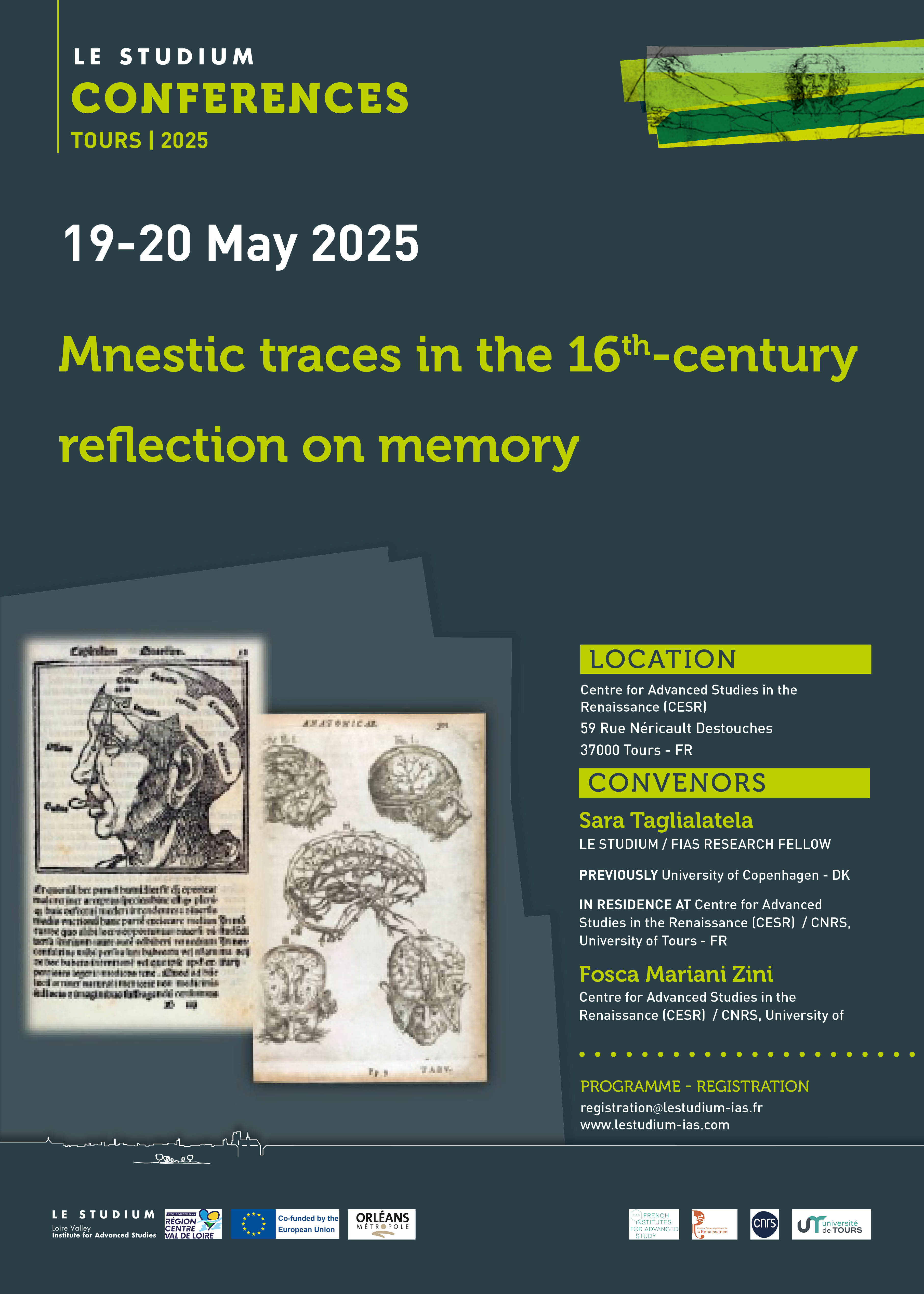
The conference intends to explore the contribution of the 16th century to the elaboration of the notion of the mnestic trace by questioning not only the philosophical traditions from which the century of the Reformation and Counter-Reformation reflected on memory, but also by drawing attention to the innovations introduced as a result of the reorganisation of knowledge and the technological advancement that made possible the development of disciplines such as medical anatomy, for example.
The conference sessions will explore four thematic clusters:
1. The formation of mnestic traces: senses, emotions and memory. How are mnestic traces produced? What role do the senses and emotions play in the production of mnestic traces? What relationship exists between external experience and internal experience, between external senses and internal senses? What ensures coherence between external experience and the experience data stored in the mnestic trace?
2. The content of mnestic traces: on the relationship between memory and time. What is preserved in mnestic traces? Is what is retained contained in mnestic traces or is it remembered through them? How can the content of mnestic traces be recalled, thus making it available for other cognitive functions in the present and future? Is memory an operation performed by the memory faculty alone or does it imply the contribution of other faculties? Is there a causal relationship between the content of the mnestic trace and the individual's past experience? If there is no causal relationship with the individual's past experience, in what way is there a causal relationship between past experience, retention and recollection?
3. The location of mnestic traces: on the relationship between body and soul. Where are mnestic traces located, in the soul or in the body? What are the philosophical and scientific models for locating memory traces? What is the relationship between body and soul in 16th century theories of memory? What is the contribution of the development of anatomy as a medical discipline to the localisation of memory? Does the beginning of the physiologisation of cognitive faculties lead to changes in the conception of the mnestic trace and, consequently, in philosophical theories of memory?
4. Remembering without traces: criticism of the notion of the mnestic trace. What are the critiques of the notion of the mnestic trace that develop in the 16th century? In what field of research do they arise, what traditions of reflection on memory do they refer to and how are they shaped? Are alternative reflections and theorisations on memory proposed, i.e. which do not make use of the notion of the mnestic trace? What are the characteristics of these theories and, in particular, how do they solve the problems of the causal relationship between memory and the past and the relationship between soul and body?
The conference will bring international experts on theoretical philosophy, history of philosophy, history of medicine, and musicology to CESR, the venue of the conference and a renowned interdisciplinary center for the history of Middle Ages and Renaissance.
The two day event will contribute to contaminate the R&I ecosystem of the Le Loire Valley and of CESR by promoting the discussion on an aspect of the history of philosophy which has an undeniable impact on the contemporary understanding and reflection of the notion of memory. Given the importance of the notion of memory in many contemporary fields of research (neurosciences, psychology, medicine, sociology, ...), the conference will offer to the researchers of the region working in these disciplines the opportunity to reflect on the historical background of their researches.
CONVENORS
- Sara Taglialatela, LE STUDIUM / FIAS Research Fellow
PREVIOUSLY University of Copenhagen - DK
IN RESIDENCE AT Centre for Advanced Studies in the Renaissance (CESR) / CNRS, University of Tours - FR - Fosca Mariani Zini,
Centre for Advanced Studies in the Renaissance (CESR) / CNRS, University of Tours - FR