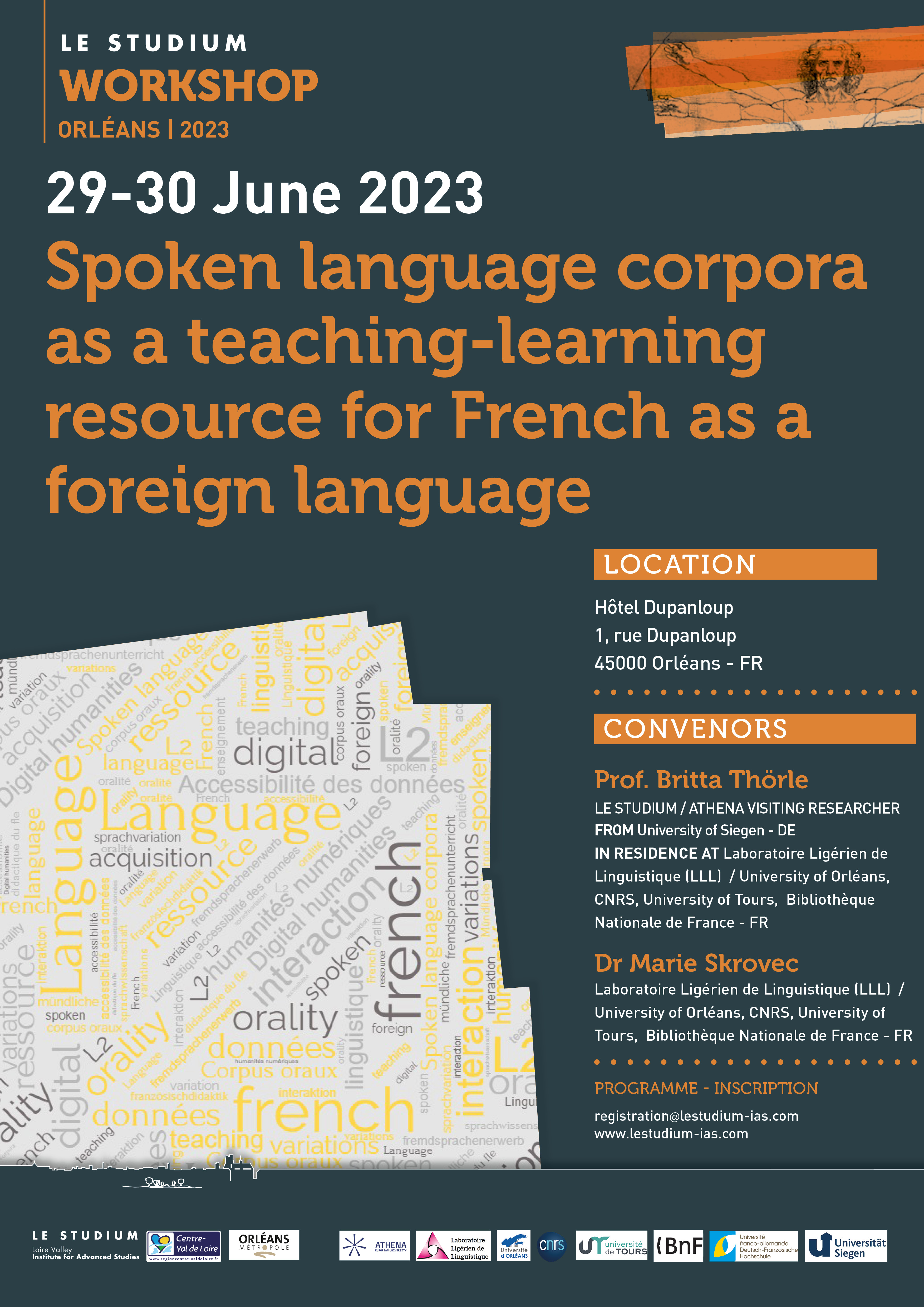
The workshop deals with the question of how spoken corpora of French can be exploited for the (university) teaching of French as a foreign language in the fields of French language and linguistics. The focus is on problems of the exploration, structuring and processing of corpus data as well as issues of the transferability and sustainability of digital resources.
The analysis of transcriptions of oral interactions has long been established as a research field in its own right within the framework of corpus linguistics and the digital humanities. It is only recently, however, that language corpora have been systematically considered as a resource for the teaching and learning of foreign languages. This is particularly true of spoken corpora which, with the audio or video recordings of authentic conversations that they contain, form an immense reservoir on which the teaching of French language and linguistics in higher education can draw. While corpora are not lacking, the task now before us is to explore their possibilities to the full and make them available for teaching and learning purposes. This applies not only to the teaching of L2 French at school and in adult education, but also to the use of corpus-based materials in the university training of teachers of French in language, (applied) linguistics and the didactics of French as a foreign language.
The workshop tackles these problems and invites researchers to exchange ideas about:
- spoken French from the perspective of L2 acquisition and foreign language didactics
- the specific potential of existing or future spoken corpora for learning and teaching French as a foreign language as well as French linguistics
- learner corpora of spoken French and problems of their creation and exploration
- improving the accessibility of digital corpus tools for non-specialised users outside the community of (corpus) linguists
- principles and methods of corpus exploration from a didactic point of view
- possibilities of didactization
- the creation of digital materials
- publication issues; accessibility and sustainability
The workshop especially encourages the exchange between experienced scientists and young researchers. Doctoral and post-doctoral students will be able to present their projects and discuss them with recognized scientific experts. The following have confirmed their participation:
- Virginie André, ATILF, Université de Lorraine
- Alain Ausoni, Université de Lausanne
- Carole Etienne, ICAR, ENS Lyon
- Christian Surcouf, Université de Lausanne
- Stefania Spina, Università per Stranieri di Perugia
- Henry Tyne, CRESEM, Université de Perpignan
- Beate Weidner, Universität Duisburg-Essen
This workshop is organised in the framework of the Advanced Technology Higher Education Network Alliance (ATHENA European University) and supported by the Franco-German University.
The Franco-German University (FGU) is a network of affiliated universities from France, Germany and other countries. Its administrative offices are located in Saarbrücken, Germany. The FGU was established as an international institution following an intergovernmental agreement (the Weimar Agreement) in 1997.
The FGU provides expert guidance on relations between French and German universities with the aim of improving cooperation in the areas of university study programmes and research in both countries.
CONVENORS
Prof. Britta Thörle
FROM University of Siegen - DE
IN RESIDENCE AT Laboratoire Ligérien de Linguistique (LLL) / University of Orléans, CNRS, University of Tours, Bibliothèque Nationale de France - FR
Dr Marie Skrovec
Laboratoire Ligérien de Linguistique (LLL) / University of Orléans, CNRS, University of Tours, Bibliothèque Nationale de France - FR