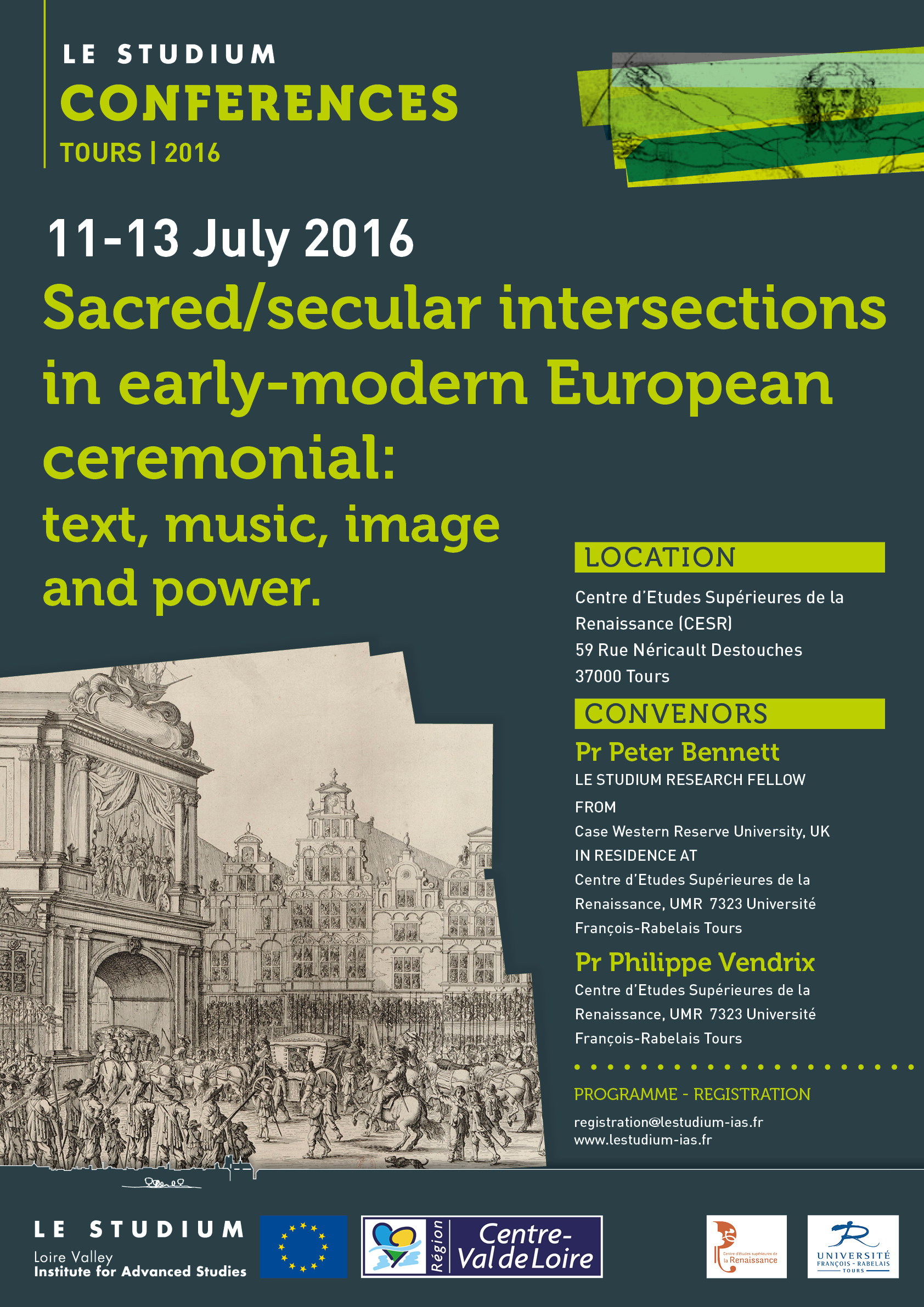
Most recent studies of early-modern festivals and ceremonies have, for the most part, focused on the urban processions which formed the most visible component of such events, and on their visual (decorations, emblems, ephemeral architecture), literary (printed accounts and festival books), and sometimes musical (fleeting descriptions of performances in the street or on a platform) dimensions. The liturgical and ecclesiastical facets to these ceremonies (and their associated music) have, however received much less attention: for the royal entrée in particular, the sacred – the ceremony in the cathedral that followed the procession through the city – arguably held just as much significance for contemporaries as the procession, even if the typical accounts published to commemorate such entrées glossed quickly over the events that occurred in the church. To be held as the culmination of a year-long Le STUDIUM project at the CESR, Tours (Louis XIII’s Paris and provincial entrées: music, liturgy and power, 1610-43) this conference takes as its starting point the sacred/secular divide (and the historical and historiographical problems it presents) and is intended to consider the early-modern festival as an event which may have actually occupied both spaces (and the liminal region between them) and to examine ways in which an exploration of this liminal region might enrich the understanding of scholars who approach the field from a wide variety of disciplines.
Convenors
- Pr Peter Bennett, LE STUDIUM RESEARCH FELLOW
FROM: Case Western Reserve University, Cleveland, OH, USA
IN RESIDENCE AT: Centre d’Etudes Supérieures de la Renaissance, UMR 7323 Université François-Rabelais Tours - Pr Philippe Vendrix
Centre d’Etudes Supérieures de la Renaissance, UMR 7323 Université François-Rabelais Tours