
Prof. Richard Freedman

Établissement d'origine
Département de Musique, Haverford College - US
Laboratoire d'accueil
Centre d’Études Supérieures de la Renaissance (CESR) / CNRS, Université de Tours - FR
Hôte scientifique
Prof. Philippe Vendrix
PROJET
Les messes imitatives de la Renaissance
Citations: The Renaissance Imitation Mass: est un programme de recherche consacré à l’édition numérique et l’analyse partagée des messes imitiatives du 16e siècle, le seul genre musical (plus ou moins 500 oeuvres) qui se déclare ouvertement construit sur du matériel pré-existant. Ce programme s’inscrit dans la suite de nombreux projets de recherche menés conjointement par Richard Freedman (Haverford College) et l’équipe Ricercar du CESR (Université de Tours) depuis plusieurs années. Il associe des chercheurs tant en musicologie qu’en humanités numériques d’institutions nord-américaines et européennes. CRIM se construit en recourant aux dernières innovations en matière de musicologie numérique et développe un nouveau système de citation des textes musicaux grâce à l'outil open-source MEI.
L’équipe de chercheurs et de doctorants menée par Freedman et ses collègues du CESR exploitent ces technologies afin de construire une base de données analytique. Celle-ci est élaborée sur la base d’observations fondées sur un vocabulaire qui décrit les relations contrapuntiques complexes qui existent au sein de ce corpus des messes en imitation. Une fois identifiées, ces observations font également l’objet de commentaires facilement identifiables grâce à des ontologies Linked Open Data and Open Annotation.
Ce projet se risquera aussi à élaborer les potentialités d’approches de la musique par processus automatiques d’analyse et d’apprentissage par deux voies : en explorant les structures mises en évidence dans le corpus choisi et en modélisant des approches de type algorithmique pour découvrir de façon automatique des structures identiques. CRIM contribuera donc à la recherche musicologique par le format de son édition numérique et par les outils d’annotation analytique grâce à la compréhension des processus de citation et grâce à l’alliance innovante entre spécialistes de la musicologie et de l’informatique.
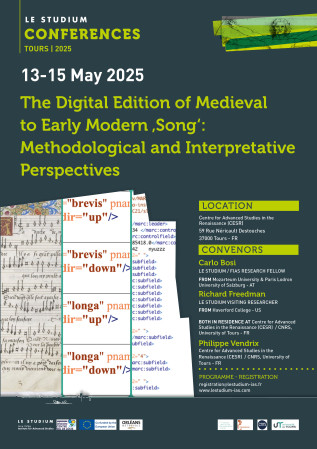
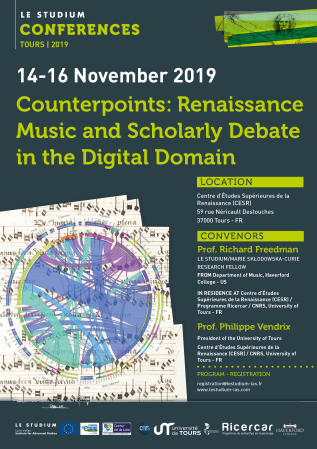
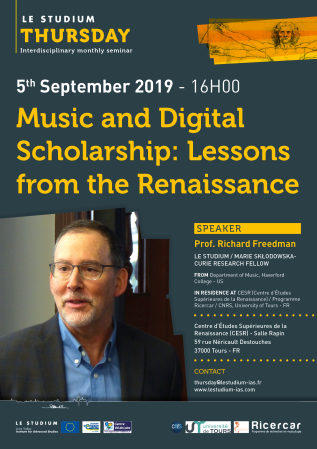
Events organised by this fellow

Publications
Final reports
Building upon recent developments in digital music scholarship, Citations: The Renaissance Imitation Mass investigates similarity and borrowing in music on a massive but detailed scale, using digital tools that only a few years ago were beyond our grasp. Our work focuses on the craft of musical counterpoint, and how musicians of the sixteenth century transformed pre-existing pieces to make intricate cyclic compositions from familiar sounds. The CRIM team, an accomplished group of scholars and data scientists active in Europe, North America, and Australia, will assemble a diverse collaborative network of music scholars and students at colleges, music schools and university graduate programs, extending the reach of digital scholarship to new users, and building new communities.
What does the study of music look like in an age of ubiquitous data? How have we collected and categorized music, in all its richness? And how can digital tools help us understand musical style and structure, particularly when it comes to the music of the distant past? As my host Philippe Vendrix explains in the introduction to EarlyMuse (https://earlymuse.eu/; a major European Cooperation in Science and Technology [COST] project), the field of early music has always been marked by hybridity: a meeting ground of theory and practice, of scholarship and performance, of the material and the immaterial. Now the digital turn in scholarship, and the central place of digital media in culture more broadly, bring new opportunities and challenges to this mix.
The experimental basis of my project, briefly stated, is to find ways to advance two key axes—one technical, the other social. Thus, one portion of my work will focus on “music as data” and “data about music” at both micro and macro levels of detail. During this phase of work, I will advance techniques for the curation of quality data, the development of algorithms and machine learning systems for music, and the elaboration of systems for mapping and linking knowledge. But I will also help seasoned professionals and aspiring graduate students alike direct this kind of “applied human intelligence” to the machine tools that increasingly mediate our experience with all forms of culture, and that shape knowledge systems, too. If musicology is to succeed in a digital age, we will need to involve digital natives in this work. And if young musicologists are to succeed in the rapidly changing landscape of the academy and culture industry more broadly, they will need to hone digital skills early in their careers